For a generation, the Weave had settled into a pulse as steady and sure as the tide. Across Veltryss, the guilds meticulously maintained their ledgers, the schools inscribed their glyphs with methodical precision, and the great thoroughfares of Peridawn, Calidell, and Ilmarane hummed with the basso profundo of tethered magic. The occasional misfire—fizzling like a dampened fuse, or snuffed with an exception burst—was counted as a minor derangement, easily recorded, neatly explained. The world, it seemed, had reached an equipoise, learning the weight of its own power.
But beneath the facade, the Weave’s lattice still held echoes—whispers of the first recursive experiments, the half-forgotten mutterings of dead casters, glyphs abandoned to sleep in long-untouched stone. And now, beneath that fragile equilibrium, something flexed. The stability of centuries was about to fracture, and the Weave, at last, would answer.
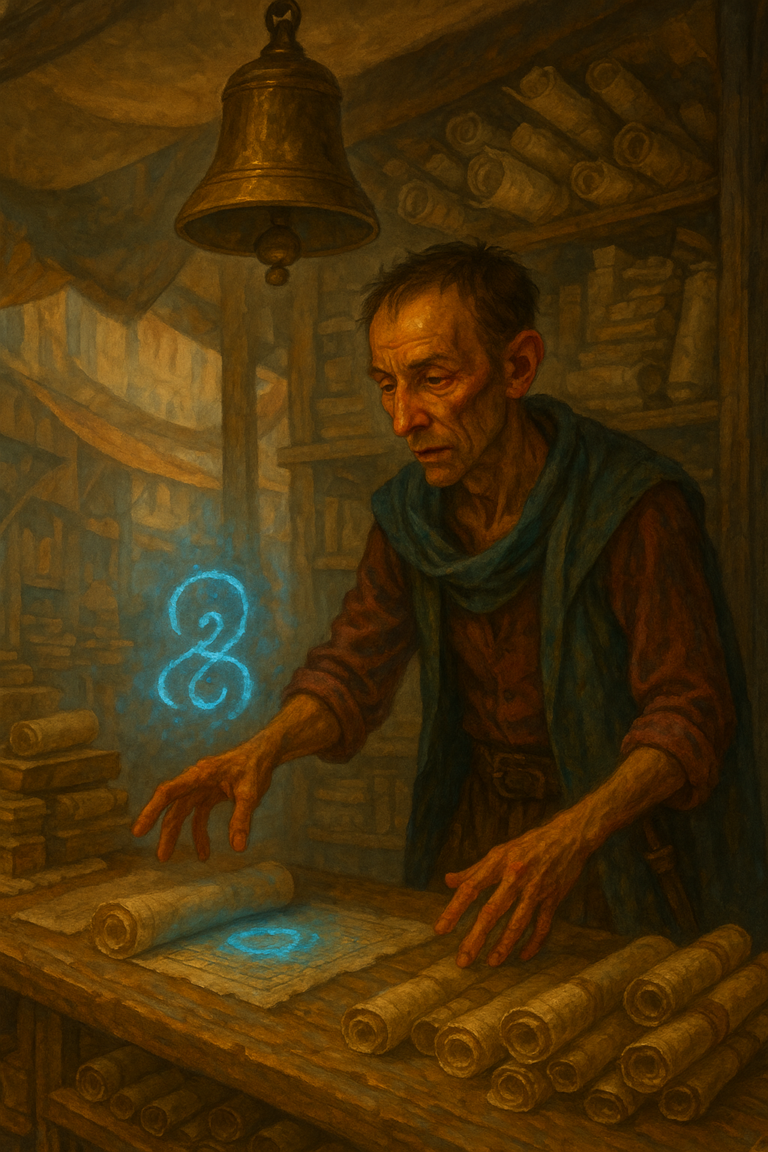
The sun was only then wrestling itself free of the eastern sky when the market’s brass bell struck. Yseid Marrin was deep in a haggling dance over a weather scroll—its sigils only halfway rendered, its binding glyphs still raw—when the bell tolled again, twice—a cadence normally meant to signal a concluded sale.
The sound carved itself through the lane’s close air, and a shudder of blue light flickered across Yseid’s counter, leaving behind a glyph no larger than a hand’s shadow. It projected a faint blue-pulse that hovered above the wood, a heartbeat’s hesitation in the air. Then it dissolved—not with the usual flicker of spent ink, but in a silent burst, its essence unraveling the instant a warden’s apprentice turned toward the disturbance.
A faint scent of ozone lingered. And worst, beneath Yseid’s ribcage, a resonance stayed behind, a hum too deep to hear yet impossible to ignore. He shouted for wardens, but the moment grew brittle under their feet, the evidence bleeding away like ink in rain.
By the time they arrived, nothing remained. The market returned to its wheedling trade. And Yseid, hands still trembling, studied the empty space where the glyph had been, the echo of that terrible second bell still tolling in his veins. (Filed as Field Note; classification pending.)
In the Containment Oversight Committee’s sterile warren, a courier placed a parchment upon a guild-warded desk. The wax seal bore a crest, and the inked heading was unmistakable: UNREGISTERED GLYPH RESIDUE – INCIDENT LOG.
The clerk’s quill paused. Ink flowed:
“Market in Peridawn. Brass bell tolled without purchase. Blue-pulse glyph detected; before the warden could intervene it already went dormant. Zero casualties. First unlogged anomaly in six months.”
A tag was stamped beside it: ANOMALY-001. The ink barely had time to dry before the central ledger thrummed—a faint, metallic hum—the Weave itself acknowledging the aberration.
The swam-lands on Calidell’s fringe were thick with the slow, sodden breath of rot and wet stone. Tesla Var crouched beside a bloodied farmer, the man’s leg crushed beneath a fallen log. Without ceremony, she invoked the mending glyph—its familiar golden sigil unbending itself from her left hand, binding the tears in skin and muscle.
The flesh sealed.
And then the glyph kept going.
Emerald vines erupted from the healing mark, questing tendrils that reached for the braided sigils on Tesla’s focus-rings. The residual healing magic sought the nearest magical signatures and latched onto the ring-sigils. She slashed them with a severance glyph, sparks spitting from the cast. The tendrils recoiled—but not in surrender. Instead, they lunged, snarling around the very rings meant to restrain them.
The sky was grey. But the air abruptly tasted of fresh earth and spring, and Tesla’s pulse hammered. When the vines finally unwound, they withered before her eyes, their last gasp exhaled as a whisper of green mist.
The farmer stood, healed. But his stare lingered on the faint green luminosity clinging to the rings’ silver arcs—and on Tesla’s hands, which trembled because her safeguards suddenly felt insufficient.
The farming collective’s glyph-veined channels had never faltered. Their blue-scripted irrigation threads carried water with the exact, measured rhythm of a heartbeat. Because the irrigation glyphs form a region-spanning network, a single malfunction can cascade through every channel. When the same cadence that unsettled Tesla’s glyphs rippled this far, the lines shattered—into rivers, into a thousand tributaries.
A split. A spasm. The faint blue threads—meant to nurture, not to subjugate—bloomed outward. Stone channels shiver-fractured. By the second hour, fields meant to be parched were swallowed beneath a new and deliberate tide.
Farmers waded through water that shouldn’t have been there, frantically severing glyph-segments with iron shears, their shouts lost beneath the rush. The glyphs died under the strikes—but only sulkingly. The irrigation stones pulsed, stubborn, their cracks weeping ghost-lines of blue. Not drowned, not dead—simply changing.
By dusk, a dozen homes were streaked with rivulet-scored walls. And the collective’s overseer, inked script in hand, stalked toward the Guild’s quarters to beg for answers. (Filed as Field Note; classification pending.)
The Hall of Ilmarane’s crystal-lattice observatories were meant to bend light—not rewrite it.
Nyzari’s lens array framed the hallway’s illumination glyph as it should have: a measured, amber glow designed to fade just below the threshold of intrusiveness. But now, the light wasn’t listening.
The beam was splintering. Not into lesser lumens. Into infinitely smaller sub-beams, each behaving as an independent pulse. Every beat produced a dozen more, a nesting fractal too small to see yet too present to ignore.
Nyzari’s notes were crisp, her hand unwavering:
“Self-nested script. Unscripted rhythm. Pattern congruent with Cascade-adjacent rhythms.”
The projection sputtered under her authority, and the report thrummed into the city’s veins as ANOMALY-002. The Weave, she knew, was writing back to itself.
Across the continent, in the shadows of old guild halls and the silent hollows of forgotten sanctums, the Arcane Watchers vibrated. Though long dormant, their mechanized frames registered a single, synchronized spike—a heartbeat-long ping—in every node of the network. The log marked three sites for field confirmation: Aurnoth’s Quarantined Grove, the ruined carcass of a Watcher in Valand, and the Ivory Bastion’s towering halls.
The guild’s central system recorded WATCHER-PING-01 and noted—with cold efficiency—that no Watcher had been summoned. Dormant Watchers still share a passive heartbeat; any anomalous pulse echoes on every node.
The dawn’s hesitant light barely brushed the canopy of the Kharveth Enclave, where the air hung thick and watchful. The Quarantined Grove, a prison of crystal-woven glyphs, was meant to be silent—a place where no growth might twist free of its wards. Yet now, the glyphs trembled, destabilized by the spreading cascade.
A crackling shudder passed through the barrier. The spellwrought walls flickered violet, the glyphs warping like glass under sudden heat. Then—erupting forth—came a burst of raw, crackling energy, an exception burst that split the air with a sound like shattering crystal. The sealed grove’s heart detonated in a cascade of brittle bloom, a nightmare forest of serrated, obsidian-like petals unfurling in a storm of sound and light.
The blossoms thrummed. Each crystalline flower pulsed with a high, ghostly warbling that hummed against the bones of wardens rushing forward. They chanted, sketching desperate glyphs of containment in the frigid air. But the glass-frosted tendrils proliferated, splintering farther, their fragments tumbling beyond the grove’s suffocating embrace.
An hour of chaos. A forest glittering with shards. And though the glyphs dimmed back toward sleep, the wardens knew the afterglow lingered—overmagic: energy that outruns its bounds. Filed as a field-attachment to WATCHER-PING-01; containment notes pending.
Kaelen Darnell’s fingers hovered over the vellum, his dormitory steeped in the stale ink and candle wax musk of late-night study. The glyph he’d glimpsed in the market haunted his memory—snatched from the dark behind an unseen mage’s hand. It wasn’t supposed to defy replication. He steeled himself.
The midnight-blue ink rebelled, slipping away like quicksilver as his touch approached. He pressed harder. The vellum hummed—a deep, gut-rattling sound. Then the lines dissolved.
A second sheet, untouched moments prior, now bore the sigil—perfectly wrought—without his stylus ever touching it—as though seared into the parchment by a phantom hand. A quiver of vibration ghosted through his stylus, his pulse quickening in counter-rhythm.
The glyph had become self-replicating, able to rewrite ink on any surface it touched. He pocketed the page like a relic, the sound of the glyph’s own song a quiet echo in his veins. It wasn’t inked. It was alive.
Candlelight trembled atop brittle aether-skin as the Arcane Literacy hall bristled with ink-wielding hands. The invigilator’s gavel struck for the first exercise: a flawless transcription of three containment glyphs. Simple. Clean.
Then—an eruption.
The fresh parchments pulsed. Old sigils, brittle and half-vanished, seeped through beneath dozens of styluses. The whispers of past exams, long-forgotten and erased yet enduring, surfaced at once. The glyphs moved, flickering like embers caught in a sudden draft. The room dissolved into murmurs, growing louder, then shouts.
Dozens of hands scraped at the ink, desperate. The glyphs obeyed—sort of. They vanished only to resurrect elsewhere: on fresh sheets, over ink-stained fingers. The hall became a night-darkened page, its words alive.
The exam aborted. The halls were cleared. Quench wards flared; null-ink washed the desks. The scribes still called it. The note of ANOMALY-003 thrummed through the corridors like a fever-filled breath.
The hall’s vaulted ceiling absorbed the guild’s new trade edict, spell-scribed to be thundered aloud and then fade. Instead, the instant the proclamation was sung forth, the hall grew sick of itself.
The last sentence reverberated into the next. And again. And again. With each recursion, the inscription amplified the spoken words, and the spell warped itself; ink on the scribe’s page twisted, one whispered phrase spilling into the next, ever slurred, ever stuttered, fumbling toward some correction. The inscription’s echo amplified the spoken edict, and the spoken edict fed the inscription—an accelerating loop.
Visitors grew dazed, their thoughts dissolving in the repetition. Only when the hall’s glyphs were sealed beneath a null-ink wash did the spell sputter and die.
ANOMALY-004. Overmagic. The edict had exceeded its bounds. It hadn’t been a speech. The spell itself had become a mouth that kept speaking.
By midday, Peridawn’s scribes were pasting thick, crackling broadsides onto stone and market-wood. The headlines had the texture of a warning’s first brittle layer:
“Spells Remembering Themselves: Living Glyphs Sighted.”
“The Groves Bleed: Wardens Report Unprecedented Growth.”
“Bastion’s Edict Uncaged: Citizens Urged Not to Repeat It.”
At the foot of each notice, a small, inked glyph—a question mark, hand-drawn, as though the very script wasn’t sure of itself anymore. A fine, barely-there tremble in the aether-skin’s weave, as though the words themselves were itching to stray.
The whispers didn’t need ink to spread.
The city—the world—was uneven now. And something had woken up. Every report whispered the same thing between lines: a two-beat blue pulse.
In the sprawl of Peridawn, iron rails hummed beneath the city’s pulse, the tram wards a delicate poetry written in light. Each sigil was a heartbeat, a silent metronome marking the coming and going of passage. Then, on a morning crackling with premature summer, the sigil stopped.
Passengers felt it first—a lurch, not of motion, but of time. Bodies sagged with an impossible weightlessness, suspended between the familiar click-clack of the rails and the sudden certainty that the doors ahead had already opened before the tram itself finished gliding into the station.
The doors opened with a soft whisper, revealing nothing: a ghost platform, pristine and hollow. Engineers logged it as a time-echo of the station, seconds out of phase. Engineers from the Containment Oversight Committee arrived swiftly, eyes darting beneath the brims of their guild-issue keffiyehs. “Scheduled maintenance,” they intoned, not quite meeting anyone’s gaze. But the word crash—the hard, brittle kind that shatters spellcraft—hung in the air with a faint ozone scent.
ANOMALY-005: severe temporal distortion. Cause: a corrupted tram sigil, destabilized by the cascade, created a brief temporal echo.
The wind bit salted as Miren untethered her nets from the weather-worn bow of the Mariskin. Her voice was the last thing audible over Orvand’s murmuring tides: a working, a blessing, a trickster’s wager with the sea. The words were old, passed down like the hearth’s flicker—yet this morning, the water answered.
A counter-syllable—the sea’s own answer to a binding word—rose: a ripple under the hull, a susurration half-memory, half-moth’s wings—threading itself beneath the weight of her song. Villagers on the harbor’s fringe straightened. The tide-stone suddenly glowed with the dawn’s pallor, its veins pulsing dim blue, as if the stone had turned inside-out to exhale.
The fisheries’ log chose careful phrasing: ANOMALY-006: “Tide-binding resonance observed. No adverse effects; unusual echo detected.” Beneath that, a trembling ink-splotch betrayed the scribe’s disquiet.
The night was a dark-eyed thing, pregnant with the kind of stillness that presages something vast. Hara, the lighthouse keeper, had seen the beam’s slow, sure sweep a thousand times, a silvered thread spooling between the stars and the restless dark below. Tonight, when the glass should have pulsed once, twice, thrice; it fractured.
The rupture was not in the lens or the glyphs but in the light itself. Where there should have been a single beam, there was a tree of light, branching endlessly outward, each tendril farther than the last, each fragment whispering something neither sky nor sea could name. The dune-foam beyond the breakers rippled with reflections of impossible coastlines. Ships’ cabin-lanterns extinguished themselves, as though the glass could not bear false witness.
Hara wound the crone’s gears, wrenching them into right alignment. Nothing. The beam’s recursive fractal resisted recalibration. At dawn, the incident was logged as ANOMALY-007: “Self-nesting light. Refractive behavior outside containment parameters.” In the margin, she half-scrawled a thought:
Tendrils of an echo’s echo. The heart of the fracture is still whispering.
No vessels lost; the harbor master ordered a stand-off till dawn.
The Hall of Echoes was neither large nor grand, merely a cavern-mouth beneath the roots of Valand’s high stone, its walls scored with the names of the dead. The rite was flawless—or so it had always been: the ward, the whisper, the slow, inevitable surfacing of the name.
It should have been Eryndra.
Instead, the first syllable was still fading when the spell surged. A wrongness, an itch beneath the skin, as the syllables coiled inward. The name that returned was a misstep, a shadow’s cousin—and when it touched the casters’ minds, it bore into them. Heads thudded back, hands clutched at temples, every mouth a mirror to the others, lips silently shaping the trespasser’s name:
Eryndor.
Archivists suspected the Weave briefly shifted phonemes—a test of the rite’s indexing.
The glyphs stuttered at the sound, their edges shimmering before snuffing out like guttering candles. The archivists were already composing the report as the last of the dazed participants stumbled from the hall: ANOMALY-008: “Memory glyph misfire. Over-propagation of ancestral name. No measurable harm. Echoes detected.”
In the darkest corner, where the oldest inscriptions lay half-bared beneath centuries of dust, a single wrought-iron door’s latch began to tremble. The draft that slithered beneath it did not smell of stone or wind.
It smelled of ink.
Beneath the peeled paint and sagging beams of the guildhall in Valand, a long-dead Arcane Watcher stirred without the call of a summoning glyph. Its amber eye cracked open, its glow sharpened to a brittle edge, and for a fleeting second it fixed upon a nearly effaced glyph in the floor. Then a drone—deep, guttural, like a warning from before memory—echoed through the hollow halls. The Watcher spasmed once, twice, reacting to a lingering cascade echo, and stilled.
The stone beneath it held the warmth of old magic briefly, lingering like a ghost’s passing. Somewhere in the records, a scribe would soon write:
ANOMALY-009: soft anomaly. Dormant sentinels are not meant to stir without purpose. Valand node confirmed as one of the three sites flagged in WATCHER-PING-01.
Every dawn, the guild’s mages stood upon the wind-scorched cliffs of Jilren and performed a weather-stabilizing chant for the market below. This morning, their harmony split.
The first strand drew forth a drizzle, silver in the pale light, stitching the air with slow, controlled rain. The second—cracked from the whole like a shattering vessel—ripped the moisture from the sky and hurled it across the market square, a wind-whipped tide of sheets and scraps and overturned wares.
A child’s cry. Spice-cans skittering over stone. A dozen vendors shouted curses at the clouds. Beneath it all, the Weave groaned, as if stitched together with straining thread.
ANOMALY-010: fracture. Ward-harmonics drifted out of phase under the spreading cascade.
The actors of the Wandering Veil bowed beneath their false forest, the painted sky of Peridawn’s square alive with illusionary leaves. The murmured lines. The practiced stillness. Then darkness—at least, it should have been.
But the glamour did not fade.
It latched like a leech. The forest kept whispering against stone. The characters could not shed their skins. The troupe’s youngest acrobat could not will his limbs to stillness; the chief chronicler’s voice would not break from its measured cadence. The audience stammered, half-laughing, half-horrified, trapped in a play that refused its final curtain.
By nightfall, the bakers and silkmongers had had enough.
ANOMALY-011: lingering glamour. A ward-speaker cut the glamour with a blunt null-chord; the forest sighed out.
Rolf’s hands hovered over the aether-skin, his brush poised above the third and final stroke of the weather-stilling glyph. A shuddering breath. A whispered enchantment. Then—the ripple.
The glyph’s mirrored self wrenched free of the parchment, flawed and skewed. Then another. And another.
Like a fevered sketching, they multiplied beneath his ink, each iteration warped, recursive. The satchel was meant to drown them; the sea would remember better.
But the scrolls dissolved upward, ash-laden and brittle, exhaling a scent that clings to ancient scriptoria. The cascade-touched glyph destabilized the aether-skin itself, turning it to lifting ash.
By evening, the market’s tongues had set the tale to fire. The scribes finally marked it:
ANOMALY-012: self-propagating glyph, parentless.
In the vaulted hush of the Containment Oversight Committee’s archives, Thane, senior scribe, let the candlelight tremble over the day’s reports. Nyzari Voel’s tangled illumination thrummed upon his screen, its heartbeat-like pulse steady.
Then, the stone’s own hum.
The notes beneath his desk seemed to sing. The columns exhaled mist—the thin, blue-veined ghosts of things that should not yet wake. And upon that mist, a voice—not present, yet unmistakable.
Liora.
The name spiraled the length of the hall, then was gone.
But not before four sets of eyes widened across the world. Not before the sound caught:
- Varek Null’s mind, where the Blackroot Spire’s dark kept no more secrets.
- Kaelen Darnell’s trembling, where the dormitory’s floorboards could hide nothing.
- Tesla Var’s calloused hands, where the vines hummed along.
- Cirelle Thorne’s hollowed script, where the erased ink stirred.
And beneath their skin, beneath wind and stone, a Watcher’s one good eye flickered once more. Etched upon it, like a heartbeat:
A glyph.
Alive. Growing.
The Cascade was no longer alone.
And the Weave remembered.
About the Author